A non-fungible token (NFT) is a unique and non-interchangeable unit of data stored on a digital ledger (blockchain).[1] NFTs can be associated with easily-reproducible items such as photos, videos, 3D models, audio, and other types of digital files as unique items (analogous to a certificate of authenticity). NFTs use blockchain technology to provide a public proof of ownership. Copies of the original file are not restricted to the owner of the NFT, and can be copied and shared like any file. The lack of interchangeability (fungibility) distinguishes NFTs from blockchain cryptocurrencies, such as Bitcoin.
NFTs have drawn criticism with respect to the energy cost and carbon footprint associated with validating blockchain transactions as well as its frequent use in art scams.[2][3] Further criticisms challenge the usefulness of establishing proof of ownership in an unregulated market based on digital files that are easy to copy.[4]
Description
An NFT is a unit of data stored on a digital ledger, called a blockchain, which can be sold and traded.[5] The NFT can be associated with a particular digital or physical asset (such as a file or a physical object) and a license to use the asset for a specified purpose.[6] An NFT (and the associated license to use, copy or display the underlying asset) can be traded and sold on digital markets.[7]
NFTs function like cryptographic tokens, but, unlike cryptocurrencies like Bitcoin, NFTs are not mutually interchangeable, hence not fungible. While all bitcoins are equal, each NFT may represent a different underlying asset and thus may have a different value.[8] NFTs are created when blockchains string records of cryptographic hash, a set of characters identifying a set of data, onto previous records therefore creating a chain of identifiable data blocks.[9] This cryptographic transaction process ensures the authentication of each digital file by providing a digital signature that is used to track NFT ownership.[9] However, data links that point to details like where the art is stored can die.[10]
Copyright
Ownership of an NFT does not inherently grant copyright or intellectual property rights to whatever digital asset the token represents.[11][12] While someone may sell an NFT representing their work, the buyer will not necessarily receive copyright privileges when ownership of the NFT is changed and so the original owner is allowed to create more NFTs of the same work.[13][14] In that sense, an NFT is merely a proof of ownership that is separate from a copyright.[12][15] According to legal scholar Rebecca Tushnet, "In one sense, the purchaser acquires whatever the art world thinks they have acquired. They definitely do not own the copyright to the underlying work unless it is explicitly transferred."[16] In practice, NFT purchasers do not generally acquire the copyright of the underlying artwork.[17]
Uses
The unique identity and ownership of an NFT is verifiable via the blockchain ledger.[18] Ownership of the NFT is often associated with a license to use the underlying digital asset, but generally does not confer copyright to the buyer, some agreements only grant a license for personal, non-commercial use, while other licenses also allow commercial use of the underlying digital asset.[19]
Digital art
Digital art was an early use case for NFTs, because of the blockchain's ability to assure the unique signature and ownership of NFTs.[20] The digital artwork entitled Everydays: the First 5000 Days, by artist Mike Winkelmann (known professionally as Beeple), sold for US$69.3 million in 2021.[7][21] This was the third-highest auction price for a work by living artist, after works by Jeff Koons and David Hockney, respectively.
Another Beeple piece entitled Crossroad, a 10-second video showing animated pedestrians walking past a figure of Donald Trump, sold for US$6.6 million at Nifty Gateway in March 2021.[22][23]
Curio Cards, a digital set of 30 unique cards considered to be the first NFT art collectibles on the Ethereum blockchain,[24] sold for $1.2 million at Christie's Post-War to Present auction.[25] The lot included the card "17b," a digital "misprint" (a series of which were made by mistake).[26]
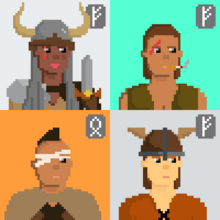
Some NFT collections are examples of generative art, where many different images can be created by assembling a selection of simple picture components in different combinations.[27]
In March 2021, the blockchain company Injective Protocol bought a $95,000 original screen print entitled "Morons (White)" from English graffiti artist Banksy, and filmed somebody burning it with a cigarette lighter, with the video being minted and sold as an NFT.[28][29] The person who destroyed the artwork, who called themselves "Burnt Banksy", described the act was a way to transfer a physical work of art to the NFT space.[30]
Stolen digital artworks are often fraudulently sold as NFTs.[31] In their announcement of developing NFT support for the graphics editor Photoshop, Adobe has proposed creating an InterPlanetary File System database in order to better guarantee the proper attribution of NFT art.[32]
Games
NFTs can be used to represent in-game assets, such as digital plots of land, which are controlled by the user instead of the game developer.[33] NFTs allow assets to be traded on third-party marketplaces without permission from the game developer.[34]
In October 2021, developer Valve banned applications that use blockchain technology or NFTs to exchange value or game artifacts from their Steam platform.[35]
Virtual worlds
Some private online communities have been formed around the confirmed ownership of certain NFT releases.[36][37]
Virtual worlds such as Decentraland, The Sandbox, and Somnium Space allow users to create galleries to show off NFT art and NFT in-game items. NFTs have been used to auction off virtual land within the games. In June 2021, a plot of virtual land sized 16 acres on Decentraland was sold for $913,228.20.[38]
Music
Blockchain and the technology enabling the network have given the opportunity for musicians to tokenize and publish their work as non-fungible tokens. As their popularity grew in 2021, NFTs were used by artists and touring musicians to recuperate lost income due to the 2020 COVID-19 pandemic.[39] In February 2021, NFTs reportedly generated around $25 million within the music industry.[40] On February 28, 2021, electronic dance musician 3LAU sold a collection of 33 NFTs for a total of $11.7 million to commemorate the three-year anniversary of his Ultraviolet album.[41][42] On March 3, 2021, rock band Kings of Leon became the first to announce the release of a new album, When You See Yourself, in the form of an NFT which generated a reported $2 million in sales.[43] Other musicians that have used NFTs include American rapper Lil Pump,[44][45][46] visual artist Shepard Fairey in collaboration with record producer Mike Dean,[47] and rapper Eminem.[48]
Film
In May 2018, 20th Century Fox partnered with Atom Tickets and released limited-edition Deadpool 2 digital posters to promote the film. They were available from OpenSea and the GFT exchange.[49][50] In March 2021 Adam Benzine's 2015 documentary Claude Lanzmann: Spectres of the Shoah became the first motion picture and documentary film to be auctioned as an NFT.[51]
Other projects in the film industry using NFTs include the announcement that an exclusive NFT artwork collection will be released for Godzilla vs. Kong[52] and director Kevin Smith announcing in April 2021 that his forthcoming horror movie Killroy Was Here would be released as an NFT.[53] The 2021 film Zero Contact, directed by Rick Dugdale and starring Anthony Hopkins, was also released as an NFT.[54][55]
In April 2021, an NFT associated with the score of the movie Triumph, composed by Gregg Leonard, was minted as the first NFT for a feature film score.[56]
In November 2021, film director Quentin Tarantino released seven NFTs based on uncut scenes of Pulp Fiction. Miramax subsequently filed a lawsuit claiming that their film rights were violated.[57]
Other uses
A number of internet memes have been associated with NFTs, which were minted and sold by their creators or by their subjects.[58] Examples include Doge, an image of a Shiba Inu dog whose NFT was sold for $4 million in June 2021,[59] as well as Charlie Bit My Finger,[60] Nyan Cat[61] and Disaster Girl.[62]
Some porn stars have also tokenized their pornographic work, allowing for the sale of unique content for their customers, though hostility from NFT marketplaces towards pornographic material has presented significant drawbacks for creators.[63][64]
In May 2021, UC Berkeley announced that it would be auctioning NFTs for the patent disclosures for two Nobel Prize-winning inventions: CRISPR-Cas9 gene editing and cancer immunotherapy.[65] The university will continue to own the patents for these inventions, as the NFTs relate only to the university patent disclosure form, an internal form used by the university for researchers to disclose inventions.[65] The NFTs were sold on June 8, 2021, for 22 ETH (ca. $55,000).[66]
Tickets, for any type of event, have been suggested for sale as NFTs.[67][68][69] Such proposals would enable event organizers or performers to garner royalties on resales.[70]
The first credited political protest NFT ("Destruction of Nazi Monument Symbolizing Contemporary Lithuania") was a video filmed by Professor Stanislovas Tomas on April 8, 2019, and minted on March 29th, 2021. In the video, Tomas uses a sledgehammer to destroy a state-sponsored Lithuanian plaque located on the Lithuanian Academy of Sciences honoring Nazi war criminal Jonas Noreika.[71][72]
Standards in blockchains
Specific token standards have been created to support various blockchain use-cases. Ethereum was the first blockchain to support NFTs with its ERC-721 standard and is currently the most widely used. Many other blockchains have added or plan to add support for NFTs with their growing popularity.[73]
Ethereum
ERC-721[73] was the first standard for representing non-fungible digital assets on the Ethereum blockchain. ERC-721 is an inheritable Solidity smart contract standard, meaning that developers can create new ERC-721-compliant contracts by importing them from the OpenZeppelin library. ERC-721 provides core methods that allow tracking the owner of a unique identifier, as well as a permissioned way for the owner to transfer the asset to others.[74]
The ERC-1155 standard[73] offers "semi-fungibility", as well as providing a superset of ERC-721 functionality (meaning that an ERC-721 asset could be built using ERC-1155). Unlike ERC-721 where a unique ID represents a single asset, the unique ID of an ERC-1155 token represent a class of assets, and there is an additional quantity field to represent the amount of the class that a particular wallet has.[75] The assets under the same class are interchangeable, and the user can transfer any amount of assets to others.[75]
Because Ethereum currently has high transaction fees (known as gas fees), layer 2 solutions for Ethereum have emerged which also supports NFTs:
- Immutable X - Immutable X is a layer 2 protocol for Ethereum designed specifically for NFTs, utilizing ZK rollups to eliminate gas fees for transactions.
- Polygon - Formerly known as the Matic Network, Polygon is a proof-of-stake blockchain which is supported by major NFT marketplaces such as OpenSea.
Other blockchains
- Bitcoin Cash - Bitcoin Cash supports NFTs and powers the Juungle NFT marketplace.[76][77]
- Cardano - Cardano introduced native tokens that would enable the creation of NFTs without smart contracts with its March 2021 update. Cardano NFT marketplaces include CNFT and Theos.[78][79]
- FLOW - The FLOW blockchain which uses proof of stake consensus model supports NFTs. Cryptokitties plans to switch from Ethereum to FLOW in the future.[76]
- GoChain - GoChain, a blockchain which bills itself as being 'eco-friendly', also supports NFTs, powering the Zeromint NFT marketplace and the VeVe app.[80]
- Solana - The Solana blockchain also supports non-fungible tokens.[81]
- Tezos - Tezos is a blockchain network that operates on proof of stake and supports the sale of NFT art.[82]
History
Early history (2011–2017)

The first known "NFT", Quantum,[83] was created by Kevin McCoy in May, 2014 and bought by Anil Dash, during a live presentation for the Seven on Seven conference at the New Museum in New York City. They referred to the technology as "monetized graphic(s)" at the time.[84] A non-fungible, tradable blockchain marker was explicitly linked to a unique work of art, via on-chain metadata (enabled by Namecoin). This is in contrast to the multi-unit, fungible, metadata-less "colored coins" of other blockchains and Counterparty.[citation needed]
In October 2015, the first NFT project, Etheria, was launched and demonstrated at DEVCON 1, Ethereum's first developer conference, in London, UK, three months after the launch of the Ethereum blockchain. Most of Etheria's 457 purchasable and tradable hexagonal tiles went unsold for more than 5 years until March 13, 2021, when renewed interest in NFTs sparked a buying frenzy. Within 24 hours, all tiles of the current version and a prior version, each hardcoded to 1 ETH ($0.43 cents at the time of launch), were sold for a total of $1.4 million.[85]
The term "NFT" only gained currency with the ERC-721 standard, first proposed in 2017 via the Ethereum GitHub, following the launch of various NFT projects that year.[86][87] These include Curio Cards, CryptoPunks (a project to trade unique cartoon characters, released by the American studio Larva Labs on the Ethereum blockchain)[88][89][90] and the Decentraland platform. All three projects were referenced in the original proposal along with rare Pepe trading cards.[86]
Public awareness (Late 2017–2021)
Public awareness in NFTs began with the success of CryptoKitties, an online game where players adopt and trade virtual cats. Soon after release, the project went viral, raising a $12.5 million investment, with some kitties selling for over $100,000 each.[91][92][93] Following its success, CryptoKitties were added to the ERC-721 standard, which was created in January, 2018 (and finalized in June),[94] and affirmed the use of the term "NFT" to refer to "non-fungible tokens."[86]
In 2018, Decentraland, a blockchain-based virtual world which first sold its tokens in August 2017, raised $26 million in an initial coin offering, and had a $20 million internal economy as of September 2018.[95][96] Following CryptoKitties' success, another similar NFT-based online game Axie Infinity was launched in March 2018, which then proceeded to become the most expensive NFT collection in May 2021.
In 2019, Nike patented a system called CryptoKicks that would use NFTs to verify the authenticity of physical sneakers and give a virtual version of the shoe to the customer.[97]
In early 2020, the developer of CryptoKitties, Dapper Labs, released the beta version of NBA TopShot, a project to sell tokenized collectibles of NBA highlights.[98] The project was built on top of Flow, a newer and more efficient blockchain compared to Ethereum.[76] Later that year, the project was released to the public and reported over $230 million in gross sales as of February 28, 2021.[99]
The NFT market experienced rapid growth during 2020, with its value tripling to $250 million.[100] In the first three months of 2021, more than $200 million were spent on NFTs.[101]
NFT buying surge (2021–present)
In the early months of 2021, interest in NFTs increased after a number of high-profile sales.[102] NFT sales in February 2021 included digital art created by the musician Grimes,[103] an NFT of the Nyan Cat meme,[104] and NFTs created by 3LAU to promote his album Ultraviolet.[41] More publicized NFT sales were made in March 2021, which included an NFT made to promote the Kings of Leon album When You See Yourself,[105][106] a $69.3 million sale of a digital work from Mike Winkelmann called Everydays: The First 5000 Days,[107][108] and an NFT made by Twitter founder Jack Dorsey that represented his first tweet.[14][109]
The speculative market for NFTs has led more investors to trade at greater volumes and rates.[108] The NFT buying surge was called an economic bubble by experts, who also compared it to the Dot-com bubble.[110][111] By mid-April 2021, demand appeared to have substantially subsided, causing prices to fall significantly; early buyers were reported to have "done supremely well" by Bloomberg Businessweek.[112][113] An NFT of the source code of the World Wide Web, credited to internet inventor computer scientist Sir Tim Berners-Lee, was auctioned in June 2021 by Sotheby’s in London,[114][115][116] and was sold for US$5.4 million.[117]
In September 2021, Sotheby's sold a bundle of 101 Bored Ape Yacht Club NFTs for $24.4 million.[118] On October 1, 2021, Christie's auctioned a full set of Curio Cards, plus the "17b" misprint, for ETH393 ($1.3 million at the time) – the first time live bidding at an auction was conducted in Ether.[119] A Sotheby's sale later that month included a CryptoPunk, various cat-based NFTs and a rare Pepe, PEPENOPOULOS, 2016, that sold for $3.6m.[120] This was the first auction hosted on Sotheby's "Metaverse", a platform specifically dedicated to NFT collectors, intended to become a biannual event.[121]
Popular culture
A comedy skit on the March 27, 2021 episode of Saturday Night Live featured characters explaining NFTs through rap to US Treasury Secretary Janet Yellen, as played by Kate McKinnon.[122]
Criticism
Storage off-chain
NFTs involving digital art generally do not store the file on the blockchain due to its size. The token functions in a way more similar to a certificate of ownership, with a web address pointing to the piece of art in question, making the art still subject to link rot.[84] Because NFTs are functionally separate from the underlying artworks, anybody can easily save a copy of an NFT's image, popularly through a right click. NFT supporters disparage this duplication of NFT artwork as a "right-clicker mentality", with one collector comparing the value of a purchased NFT to that of a status symbol "to show off that they can afford to pay that much".[123]
The "right-clicker mentality" phrase spread virally after its introduction, particularly among those that were critical of the NFT marketplace who used the term to flaunt the ability to capture digital art backed by NFT with ease.[123] This criticism was promoted by Australian programmer Geoffrey Huntley who created "The NFT Bay", modeled after The Pirate Bay. The NFT Bay advertised a torrent file purported to contain 19 terabytes of digital art NFT images. Huntley compared his work to an art project from Pauline Pantsdown, and hoped the site would help educate users on what NFTs are and are not.[124]
Environmental concerns
NFT purchases and sales are enmeshed in a controversy regarding the high-energy use, and consequent greenhouse gas emissions, associated with blockchain transactions.[125] A major aspect of this is the proof-of-work protocol required to regulate and verify blockchain transactions on networks such as Ethereum, which consumes a large amount of electricity;[126][127] estimating the carbon footprint of a given NFT transaction involves a variety of assumptions about the manner in which that transaction is set up on the blockchain, the economic behavior of blockchain miners (and the energy demands of their mining equipment),[128] as well as the amount of renewable energy being used on these networks.[129] There are also conceptual questions, such as whether the carbon footprint estimate for an NFT purchase should incorporate some portion of the ongoing energy demand of the underlying network, or just the marginal impact of that particular purchase.[130] An analogy that's been described for this is the footprint associated with an additional passenger on a given airline flight.[125]
Some more recent NFT technologies use alternative validation protocols, such as proof of stake, that have much less energy usage for a given validation cycle. Other approaches to reducing electricity include the use of off-chain transactions as part of minting an NFT.[125] A number of NFT art sites are also looking to address these concerns, and some are moving to using technologies and protocols with lower associated footprints.[131] Others now allow the option of buying carbon offsets when making NFT purchases, although the environmental benefits of this have been questioned.[132] In some instances, NFT artists have decided against selling some of their own work to limit carbon emission contributions.[133]
Artist and buyer fees
Sales platforms charge artists and buyers fees for minting, listing, claiming and secondary sales. Analysis of NFT markets in March 2021, in the immediate aftermath of Beeple's "Everydays: the First 5000 Days" selling for US$69.3 million, found that most NFT artworks were selling for less than $200, with a third selling for less than $100.[134] Those selling below $100 were being charged between 72.5 and 157.5 per cent of that amount in fees by NFT sales platforms, meaning that such artists were on average paying more money in fees than they were making in sales.[134]
Plagiarism and fraud
There have been examples of "artists having their work copied without permission" and sold as an NFT.[31] After the artist Qing Han died in 2020, her identity was assumed by a fraudster and a number of her works became available for purchase as NFTs.[135] Similarly, a seller posing as Banksy succeeded in selling an NFT supposedly made by the artist for $336,000 in 2021; with the seller in this case refunding the money after the case drew media attention.[136]
A process known as "sleepminting" can also allow a fraudster to mint an NFT in an artist's wallet and transfer it back to their own account without the artist becoming aware.[137] This allowed a white hat hacker to mint a fraudulent NFT that had seemingly originated from the wallet of the artist Beeple.[137]
The BBC reported a case of insider trading when an employee of the NFT marketplace OpenSea bought specific NFTs before they were launched, with the prior knowledge they would be promoted on the company's home page. NFT trading is an unregulated market that has no legal recourse for such abuses.
| This article uses material from the Wikipedia article Metasyntactic variable, which is released under the Creative Commons Attribution-ShareAlike 3.0 Unported License. |